
British standard
British standard. fast houses and attack in 2 age
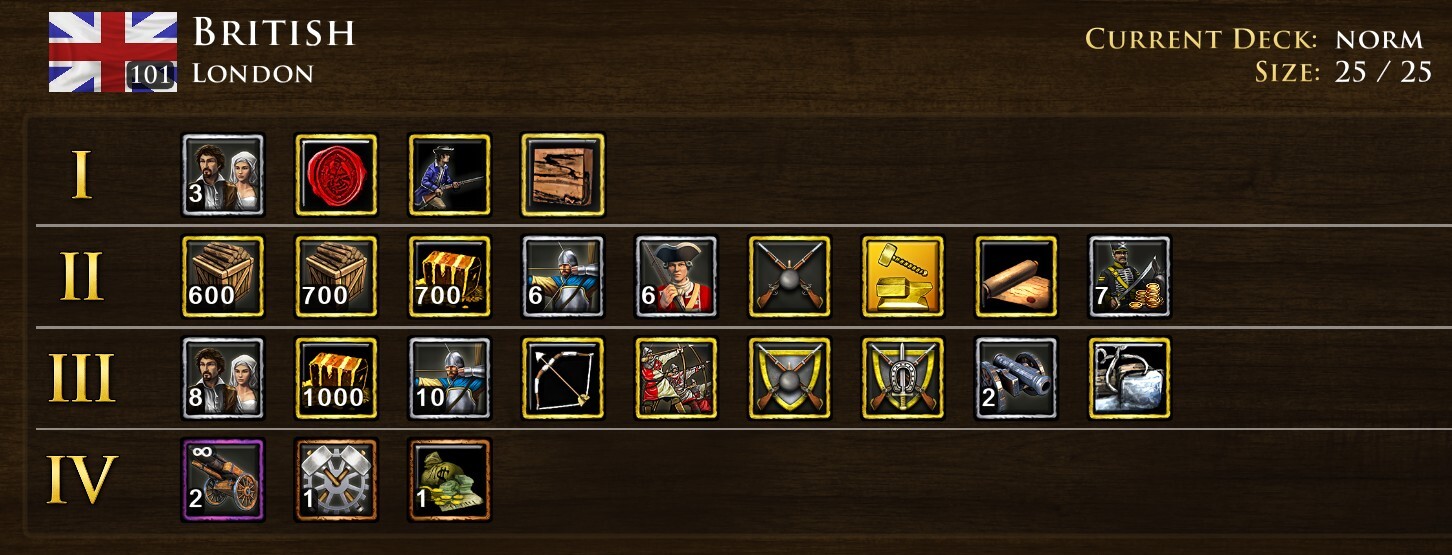
DECK: standard British
Overview
A strong opening in Age of Empires III: Definitive Edition comes down to a clear plan and clean execution. This build starts with a single house and 17 villagers, advances to the Second Age, and then branches into one of three expansion paths. Each path trades economic stability for military readiness in a different way, so you can adapt to the map, your civilization and your opponent.
Phase 1: The Opening
Begin by building a house and keep villager production running without gaps. Aim for 17 villagers before you commit to advancing. At this point your economy should be stable enough to afford the Age II upgrade without stalling production.
Key goals:
- Constant villager production
- Steady resource flow from your starting gatherers
- A clean click-up to Age II once you hit 17 villagers
Phase 2: Advancing to the Second Age
Once your 17th villager is out, advance to Age II. Move all your villagers to wood. This is the moment to choose your path. Think about your civilization's strengths, the map type, and what your opponent seems to be doing. Each option below suits a different play style.
Phase 3: Choose Your Expansion
Option A: Build 18 Houses
The pure economic route. By investing heavily in houses, you raise your population cap early, so you can keep producing units without ever getting supply-blocked. This path suits players who want to boom and out-scale the opponent, accepting some vulnerability to early aggression.
Best for: Greedy openings, peaceful maps, strong late-game civilizations.
Option B: Barracks + 16 Houses
A balanced approach. You still build a large number of houses for a solid population base, but you also add a barracks early. That gives you the option to produce military units whenever pressure appears, without giving up much economic growth.
Best for: Flexible play, mixed matchups, players who like to adapt mid-game.
Option C: 2 Barracks + 10 Houses
The aggressive route. Two barracks let you produce military units from two buildings at once, while 10 houses provide just enough population room to sustain the army. You give up some economic growth in exchange for early map control and the ability to strike first.
Best for: Rush strategies, punishing greedy opponents, competitive matchups.
Comparison at a Glance
| Path | Houses | Barracks | Focus |
|---|---|---|---|
| A | 18 | 0 | Economy / boom |
| B | 16 | 1 | Balanced |
| C | 10 | 2 | Military / aggression |
Final Tips
- Scout early. Knowing what your opponent is doing helps you pick the right option.
- Never idle your Town Center. Constant villager production is the foundation of every good build.
- Stay flexible. These paths are starting points, so adjust to what the game gives you.
Practice each variant in skirmish games against the AI before taking it into ranked matches, and you will quickly find the one that fits your style and feel comfortable with selection between versions.
CARD ORDER: 3 vills -> virginia company -> 700wood -> 600w/700g/musk/bow